
6 reasons why I was never meant to break free from corporate (but I did anyway)
A manifesto for the sensitive, fearful, and quietly certain.
I have a coaching business and multiple freelance paths since 2022. So it feels surreal to acknowledge what I used to believe: I was never meant to do this.
Leaving the only employment structure I was raised into. Starting something of my own. Living in a village. Playing by my own rules.
I’d have cringed so hard if you told me 6 years ago I’d be corporate-free. That I’d be an entrepreneur.
(The only entrepreneur I knew was networking his ass off for venture capital or pitching to his 8th investor this month. And yes—it’s a his.)
And by every reasonable measure—it shouldn’t have worked.
I was sensitive and introverted enough to work in sales but hate networking. Fearful enough to take 2 years to learn how to ride a bicycle. Emotional and impulsive enough to quit six jobs in three years and wake up broke. Plus, a complicated relationship with money—no savings, no direction—and people closest to me who didn’t believe in what I was building.
If you were betting on this business succeeding—you wouldn’t have bet on me.
And yet. Four years later, I’m still here. Still building.
Coaching nearly 100 people through their own transitions. Running a business from a garden-view office in a beach town where I also surf, dance, and grow plants.
Every single thing I thought disqualified me was actually building this vision for me.
I get into all of it below. Every disqualifier, what it cost me, and what it was quietly building when I wasn’t looking.
The parts you think disqualify you from doing what you love—you’ll meet them somewhere in there too.
1. I was highly sensitive and deeply introverted.
Every business development role I held trained me to perform extroversion. To network fiercely. Pitch confidently. Convert relationships like they are merely transactions.
Enter: me.
Someone who loathed networking events fiercely. Who got communication overload from four messaging apps running simultaneously. Who felt social fatigue after every company dinner—spending energy she didn’t have on connection that didn’t feed her.
I even secretly enjoyed the Covid lockdown. The silence and the permission to stop performing availability.
The cost was real. I was told the way I was wired was either too much or too little. Too sensitive. Too quiet. Not “social” for business development. Not political enough for leadership.
So I spent years shrinking myself to fit environments that were never built for me. Performing a version of professionalism that drained me every day. Mistaking my exhaustion for weakness rather than misalignment.
That performance cost me even more—energy, confidence, and years of believing the wrong thing about who I was.
But what those qualities actually gave me is:
My clients don’t get a coach who performs empathy. They get someone who actually feels what they’re carrying. Who sits in the silence without rushing to fill it. Who notices the thing they almost said—and surfaces it.
The sensitivity that made me a liability in corporate is exactly what makes me present in a coaching conversation in a way that changes lives.
The introversion that made me a poor networker made me a deep listener. The longing for real connection over transactional bonds is now the foundation of everything I build with the people I work with.
And my clients get a coach who actually models a corporate-free career in a garden home in Hoi An instead of a WeWork in Singapore. They aren’t being sold a vision. They’re being guided by someone who built it from the inside.
My sensitivity and introversion are the reason my clients feel genuinely seen—perhaps for the first time in a professional relationship.
I didn’t overcome this obstacle. It became my greatest professional asset.
2. I’m a fearful creature by birth.
It took me two years to learn to ride a bicycle. Six years to finish college.
I moved to Hoi An and didn’t swim in the ocean until six months later—despite living minutes from the beach. The deep sea scared me. The vastness of something I couldn’t see the bottom of.
New experiences don’t excite me first. They intimidate me first. The excitement comes later, after the fear has done its tantrum.
And I built a freelance career and a coaching business anyway—which is all about unfamiliar experiences.
First launch. First client. First package. First price. First time saying out loud: “this is what I do and this is what it’s worth.”
And I surf. Without missing any nasty wipeout, nosedive, and that time the board hit my face and left a scar on my nose.
It hasn’t been always glorious. I moved slowly when speed would have helped. I stayed on the shore longer than I needed to. I missed opportunities I couldn’t see yet because I was still gathering the courage to step toward them. ‘
Fear has a price—and I paid it in time.
But what being a fearful creature actually gave me is this:
I understand viscerally what it feels like to stand at that edge and feel the resistance in your whole body. The way fear doesn’t announce itself as fear, it just makes everything feel impossible, premature, unready.
That paralysis is neither weakness nor a sign you’re not meant for this. It’s just what unfamiliarity feels like—before it becomes familiar.
And I know something else about fear that only comes from living with it up close: it doesn’t disappear before you move.
It disappears because you move.
The bicycle didn’t get balanced until I started pedaling. And I didn’t pedal until I lifted my feet off the ground.
The ocean didn’t get less vast until I swam in it. The career transition didn’t feel less impossible until I was building it.
I don’t coach my clients from the shore. I coach them from having stood there too—and stepped forward anyway.
My fear never disappears. I only learn to move with it.
And so can you.
3. I’m emotional and impulsive
I don’t wake up at 5am. I don’t run 5km before breakfast.
I start slow. Quiet.
My mood moves with the weather. I wake up with a burst of energy one day and feel like noodles the next.
I have a lot of passion. Very little natural discipline.
And the impulsiveness? Six jobs in three years. All but the last, quit in reaction rather than intention.
I’m not the archetypal disciplined entrepreneur. I never will be.
The impulsive exits cost me my savings, momentum and self-esteem that took years to rebuild. The emotional volatility cost me the one thing an independent career needs most: consistency.
In the early years, my freelance career grew unevenly. Brilliant weeks followed by quiet ones. Projects started strong and finished on fumes.
And the most expensive price was what inconsistency did to my belief in myself. It made it hard to trust my own judgment—because the person who made a confident decision on Monday felt completely unreachable by Thursday.
But I built something that has lasted four years and is still growing.
Because I stopped trying to run my career like someone else and started designing it around how I actually work. The slow mornings. The burst days. The ebb and flow I’ve stopped fighting and started planning around.
I didn’t become more disciplined. I redesigned my work structure.
My business no longer depends on me being someone I’m not. My productivity isn’t measured by burnout standards. And when my natural working rhythm is no longer shamed and finally accepted, it relaxes and stabilizes.
Discipline is the dressing. Design is the actual bone of a sustainable independent career. And it’s built on the deepest self-knowledge.
I know how I work. I built a career that honors that.
And helping my clients do the same—build work designed for who they actually are—is one of the most important things I do.
4. I’m not good with money—and I had no financial runway at the start
Let me be honest about something most people don’t say out loud.
I didn’t just start my career transition without savings. I started it with a complicated, avoidant relationship with money.
I spent impulsively—filling my fridge with imported goods from the expats’ gourmet store I couldn’t finish in time and wiping my cards on flashy clothes I no longer keep.
Because spending was how I compensated for the deadness at work. And I only connected those two things when it was too late.
I avoided looking at the numbers. Not tracking income or expenses. Spreadsheets made me dizzy just by looking at their row-and-column matrix.
So when I finally quit, I had almost nothing saved. Within two months I was counting coins.
The cost: every early decision was made from financial desperation rather than intention.
I priced my first consulting deal too low and offered too much. Because I didn’t yet believe the work was worth taking on its own terms.
Building from scarcity distorts everything—and I built from scarcity for longer than I wanted to.
But that financially chaotic start actually gave me something no one could teach.
I understand—in my bones—why my clients avoid the financial conversation.
Why the savings account stays unopened. Why the freedom number never gets calculated. Why the preparation keeps getting postponed.
Most of us is responsible. But we have tangled up our money with our identity and self-worth. And we feel threatened to change the way we look at them.
I still don’t love spreadsheets. But I’ve learned to look at them anyway.
And the framework I now teach—the freedom number, the nine-month multiplier, the bridge job strategy didn’t come from a business course.
It came from making every mistake firsthand and understanding the real human cost of each one.
5. I had no clear direction when I started
I didn’t leave corporate with a plan. I left with exhaustion and a vague knowing it wasn’t my path.
The coaching business wasn’t a vision I had from the beginning. It emerged through years of freelancing, consulting, and eventually realizing: what I was doing informally for people around me was actually my work—helping them think through their careers, holding space for their confusion, reflecting what I saw in them.
I found my direction by moving, not by thinking.
The direction-less years were brutal—expensive in time, money, and the exhausting cycle of quitting and starting over without knowing where I was going. Clarity would have saved me years of confused decisions and unnecessary detours.
But those directionless years gave me something a clear path never could:
the intimate, firsthand knowledge of what it actually feels like to be lost. And what it takes to find your way out.
I learned to move before I had crystal clarity. To trust that the direction reveals itself through action—not through more thinking, planning, or waiting.
I believe that’s one of the most crucial entrepreneurial qualities. Not sparkling confidence or a perfect business plan. But the willingness to move anyway—and let the path become clear under your feet.
And that’s exactly what I now teach—from the inside.
How to move without a map. To start before you’re ready. To build clarity through action rather than waiting for it to arrive before you begin.
6. The people closest to me didn’t believe in what I was building
In Vietnamese culture, career prestige carries enormous weight.
A stable corporate job. A title. A recognizable company name. These are the markers of success that families understand and celebrate.
What I was building had none of those markers—especially in the early years.
The questions came from love. “How’s it going? Are you making money yet? Maybe you should look for a job, just to be safe.” They came from people who wanted the best for me—and still couldn’t grasp what I was doing.
And they wore on me.
Building without the approval of the people you love is a kind of loneliness that doesn’t ease quickly.
There were moments I almost stopped—not because I didn’t believe in what I was building, but because holding the vision alone, for that long, without anyone reflecting it back to you, is genuinely exhausting.
That’s why when my clients feel it, I don’t minimize it. I don’t tell them it’ll fade soon. I don’t offer a reframe before they’ve felt it fully.
I sit in it with them.
Because I know what it’s like to sit at a family dinner and feel like an outsider. To love the people in the room completely and still feel utterly alone in what you’re carrying.
I know what it’s like to hold a vision that hasn’t produced anything visible yet—and have to keep believing in it anyway.
That specific loneliness is one of the most underestimated costs of this transition. Most people don’t talk about it.
But it needs to be seen.
And I know something else about it that only comes from having been on the other side:
Whoever didn’t believe in what you were building were loving you with the only map of success they had.
And the vision they couldn’t see yet? It was always real. It just needed time to become visible.
So I sit with my clients in that loneliness not to fix it—but to fortify the truth: their vision is not wrong or delusional—they’re just original.
What being the wrong person actually builds
Looking back, I can see it clearly now.
The sensitivity is what allows me to write this blog post like a human in a world of machines—and coach from the heart rather than a script.
The fear is what keeps me honest. I never coach anyone toward a leap I haven’t stood at the edge of myself.
The impulsiveness is what gave me the self-knowledge to build a career that runs on energy rather than force—and show my clients how to do the same.
The financial chaos taught me the specific, human understanding of why people avoid the money conversation—and how to have it anyway.
The directionlessness showed me that movement is the answer to clarity. And helped me build the entrepreneurial skill of moving before having things figured out.
The loneliness is what allows me to sit with someone in their most isolating moment and tell them honestly—from a living memory—that their vision is real.
None of these things disqualified me.
They made me exactly the right person for this work.
And this is what I want to leave you with:
The corporate world has a very specific idea of who is built for independent work.
Confident. Extroverted. Financially savvy. Strategically clear. Disciplined. Supported.
I was none of those things.
And I’ve spent four years watching the same kind of person—sensitive, fearful, emotional, money-avoidant, directionless—create some of the most honest, most alive, most sustainable independent careers I’ve ever witnessed.
The corporate world didn’t get to decide who was qualified for this kind of work.
The people who were never meant to do this—the sensitive, fearful, confused ones —are often exactly the ones who build the most real, most human, most needed work in the world.
Not despite who they are. Because of exactly who they are.
Corporate spent years telling you that you weren’t quite right for it. Maybe it was correct.
You belong in your own work all along.
May this be your long-overdue Permission Slip to go and build it.
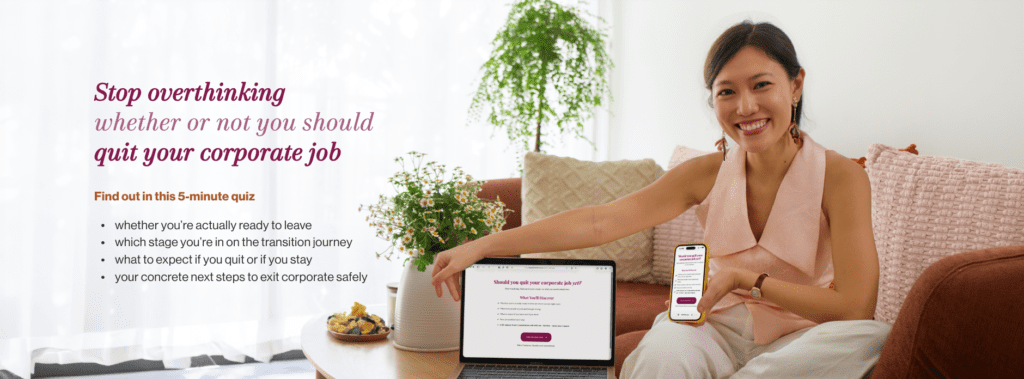
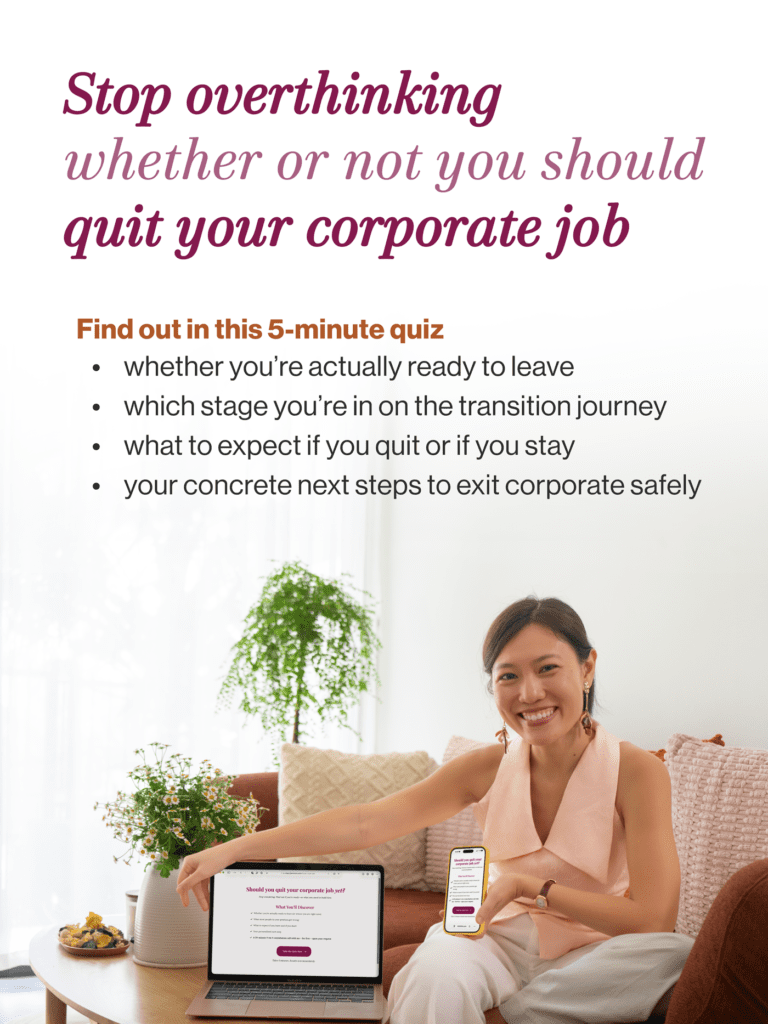
And if you’re ready to stop wondering and start moving—the Should I Quit Yet? quiz will show you exactly where you are in the transition process and your concrete next step.
👉 Take the quiz below.