
4 expensive mistakes that broke my career transition—and what I did to recover
I woke up one morning in 2020 as an unemployed and broke woman.
My bank account was near exhaustion. I had quit two months prior. Urgently, emotionally, without a plan.
I lay in bed that morning and got honest with myself for the first time in a long time.
I had quit too soon—before I had anywhere to land.
Spent too freely—as if the income would never stop.
Refused every imperfect opportunity while waiting for the perfect one.
And navigated all of it completely alone.
That morning was one of the lowest points of my career transition. And it didn’t have to be.
Four years and nearly 100 clients later, I see these same mistakes again and again.
Because we were never told what was coming.
So I’m telling you now.
Mistake 1: quit before you’re ready and confuse it with courage
Emotional and impulsive quitting looks like bravery but is actually panic.
That’s what I did.
You’ll feel relief for about three weeks. Then reality hit.
I wish someone had told me: leaving corporate isn’t a destination. It’s not the result of courage—but having built a sustainable work outside of corporate.
Without anything to sustain you, quitting before you’re ready doesn’t set you free. It just trades one kind of stress for another—one that’s lonelier and harder to recover from, because now you’re carrying the weight without the stability.
What I’d do differently:
I’d be generous with myself.
Allow yourself 6 to 24 months to build your exit intentionally. You have that kind of time.
Stay employed while you explore—actively—using the time and income you have to figure out where you actually want to go.
Test ideas. Talk to people doing work that genuinely interests you. Run small experiments. Let the direction reveal itself through movement rather than thinking.
Leave when you have something to move toward. That’s how you leave well.
Mistake 2: having no financial runway
When I quit, I had almost nothing saved. Because I had been living too well for someone planning a major life change that within two months, I was counting coins.
Financial pressure changes everything.
It doesn’t just stress you out—it slowly distorts every decision you make.
You stop asking “what do I actually want?” and start asking “what can I afford to want?”
You say yes to projects that drain you. You price too low. You take the wrong clients. All because you couldn’t afford to do otherwise.
The intentional, aligned transition I needed to build was simply impossible to build from that place.
What I’d do differently:
Calculate your real freedom number before you make any move.
What do you need monthly to live sustainably? Multiply that by nine. That’s your minimum savings target.
Then open a separate savings account today and automate a transfer from every paycheck. Pay your future self first—after your basic needs, but before lifestyle or comfort.
And while you’re building that runway, start generating side income.
Not to replace your salary immediately—but to prove to yourself, in the real world, that your new path can actually sustain you. That proof matters more than you know when the fear starts whispering.
Mistake 3: Holding out for “the one” and refused everything else
While I was broke and directionless, I kept turning down work that didn’t feel perfectly aligned with my dream.
I was holding out for the exact right thing that never came.
What saved me was a deceptively simple idea: “Actually, I could just do any reasonable job for a temporary period.”
So I took a flexible contract role. Moved to a shared apartment to cut costs. And used that stability to do the real work of figuring out my direction.
When you’ve been waiting this long for work that actually feels like yours—the idea of settling for anything less feels like a betrayal of the dream. Like you’d be giving up on yourself.
But what I’ve learned is: the perfect opportunity doesn’t arrive when you’re standing still waiting for it. It arrives when you’re moving—building skills, making connections, staying financially sufficient, and remaining open enough to recognize it when it shows up.
A bridge job—something that pays the bills while you build—isn’t settling or giving up. It’s what gives you the time, the stability, and the mental space to make good decisions instead of desperate ones.
What I’d do differently:
Release the all-or-nothing thinking. Stay resourced enough to recognize the right opportunity when it actually arrives. Take the job that pays today’s bills so you can feel safe to keep going.
Ask yourself: what’s the most useful thing I could do right now that keeps me resourced and moving—even if it isn’t exactly what I want yet?
Mistake 4: Trying to figure it out all alone
Back then, I had no mentor, no coach, no peer support, no community.
No one who had walked this path and could tell me what was coming or catch me when I was about to plunge into a wall.
Of all the mistakes I made, this one cost me the most.
And it’s also the hardest to admit—especially for high-achieving, self-sufficient people who have spent their whole lives figuring things out on their own.
There’s a quiet pride in not needing anyone. In not wanting to be a burden or appear lost or admit that you don’t have it figured out.
Except it isn’t strength. It’s just expensive.
Because the truth is: this journey is genuinely hard. Because you’re doing something you were never taught and most people in your life have never done.
They can love you and still not understand what you’re carrying. They can want the best for you and still give you advice that was never meant for someone like you.
You need people who have walked this path. Who know what the dark middle of it feels like. Who can hold the vision when you’ve temporarily lost it and tell you honestly when you’re about to make a mistake you can’t afford.
The day I hired a coach was the day my transition actually began.
What I’d do differently:
Let yourself be held and accompanied on this journey.
Build your support system before you need it. Find a mentor. Find a coach. Find a community.
Invest in guidance the way you’d invest in any resource that determines whether you succeed or fail.
Stumbling in the dark alone doesn’t make you strong. It just makes the journey longer and lonelier than it ever needed to be.
What these mistakes taught me
That morning in 2020, I thought I had destroyed my career.
I hadn’t. I had just taken the most expensive version of the lessons I needed to learn.
Two years later, I left corporate for good, moved to a beach town, and founded a coaching business from a garden home. Four years after that, I’ve coached nearly 100 people through the same struggles, and helped 23 clients build the corporate-free work they love waking up to.
The ones who move through it with the least drama and the most peace are the ones who avoid these four mistakes. Not because the transition gets easy—but because they’re resourced, prepared, and supported enough to handle what comes.
My final advice
Don’t quit before you have prepared.
Build your runway before you leap.
Accept bridge work as a strategy, not a compromise.
And for the love of everything—don’t do it alone.
You deserve more than the hard way.
Love,
Kim
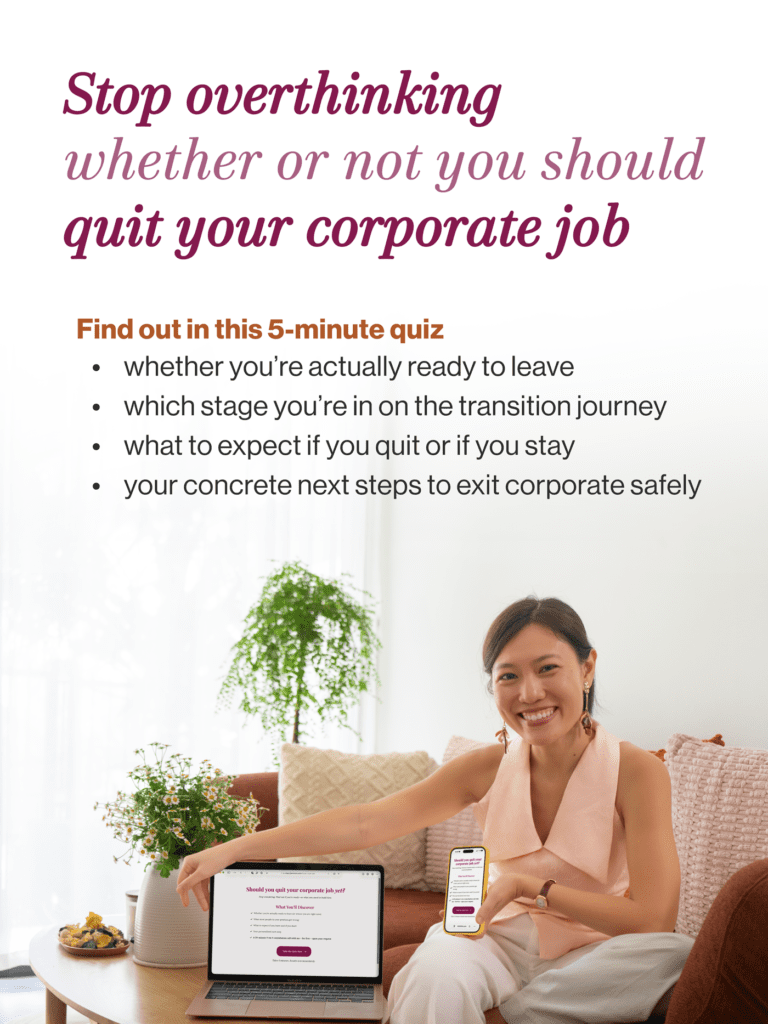
P.S. If you’re considering quitting your job, start getting to know where you are on the transition journey—and what your best career move could be from that position.
Take my 5-minute quiz and find out 👇