10 signs your career might belong outside of corporate
I still remember walking out of my office at 8 p.m. one night.
The hallway was dim. Most of the desks were empty. Outside, the April heat was still ridiculous.
I was working in one of the newest, nicest startup offices in town. And I felt like I had just been released from a sentence.
I slid my laptop bag off my shoulder, its weight suddenly unbearable, and walked toward my motorbike. With every footstep, it kept echoing:
This is not the life I want.
There was no resignation letter. No big decision. Just me in a parking lot, past dinnertime, finally admitting something I had been trying not to know.
By then, I had spent three years changing jobs. Six jobs in three years.
Every time I left, I felt relieved. Every time I started somewhere new, I thought: maybe this one.
Then, eventually, the same feeling came back.
For three years, I had been treating the job as the problem. The leadership. The company. The industry.
So I kept changing those things.
That night, I finally decided to stop looking for the right corporate job. I knew I wanted to build a career outside corporate.
And that recognition, as unglamorous as a parking lot at 8 p.m., became one of the most important moments of my career.
Because for the first time, I stopped solving the wrong problem:
Which job should I try next?
And realized that the real question was:
What kind of career and life do I actually want to build?
That clarity changed the way I moved.
I didn’t quit immediately. I stopped running from one job to the next. I started building instead.
This is what people often miss about career clarity.
It does more than change where you’re going. It changes how the remaining corporate days feel.
I was no longer waiting for my job to become right for me. I leveraged corporate for what it still gave me to build what I wanted.
The income funded my runway. The stability gave me room to experiment. The time gave me space to test, learn, save, and build. The job was part of the transition.
When I eventually left, I left corporate for good.
I relocated to Hoi An, never worked in an office building again, and turned toward the beach-town entrepreneurial life where I’ve truly found home.
You do not need to know exactly what your next career is yet.
But knowing whether you are trying to build a better career inside corporate, or beginning to build one beyond it, changes the questions you ask and the choices you make from here.
That’s the clarity these 10 signs are meant to help you find.
Phase 1—”Maybe I just need a break”
This is where most people start—feeling it, but explaining it away.
1. You rest. And the feeling comes back.
You take a holiday. Sleep more. Go somewhere nice. Turn Slack off. Come back.
And a few days later, there it is again.
I once negotiated a four-day workweek and gave up part of my salary for it. Still dreaded Sunday.
Sometimes burnout really does mean you need rest. But sometimes you rest, recover, get some life back into you, and still don’t want to return to the work.
That distinction matters.
Because there comes a point when the question is no longer:
How do I recover better from my job?
But:
Why does my job require this much recovery in the first place?
You may not be tired of working. You may be tired of working this way.
Of having to summon energy you don’t naturally have. Perform interest you don’t really feel. Stay switched on when your brain is already done. Push down the parts of you that need more depth, more quiet, more meaning, more room to work in your own way.
That kind of exhaustion runs deeper than a busy week.
Because the job itself may not be the most draining part. The constant effort of becoming the person the job needs you to be might be.
A holiday can rest your body. But if returning to work means returning to that performance, the exhaustion will keep returning too.
That’s when rest stops being the answer.
2. You used to be good at your job. Now you wonder what happened to you.
This one can really mess with your head.
You used to be good at your job. Things came naturally. You trusted yourself. People trusted you.
Then everything started taking more effort. You procrastinate on things you know perfectly well how to do. Second-guess decisions that used to take a heartbeat. Make mistakes you normally wouldn’t.
And when being capable has always been part of how you know yourself, it’s easy to think:
What happened to me?
I asked myself that a lot.
What I didn’t understand then was that competence needs fuel.
For me, that was curiosity. Creativity. Caring enough to go deeper. Having room to think and do things in a way that felt like mine.
There was less and less room for those parts of me at work. Eventually, it showed.
I still knew how to do the job. I could still do it well when I had to. I just had to drag so much more of myself there.
That’s the difference between incompetence and disengagement.
Incompetence is not knowing how to do the work. Disengagement is knowing how, but having less and less of yourself available to do it.
They can feel terrifyingly similar when you’re inside them.
So before you decide you’ve lost your edge, look at the fuel.
Your ability may still be yours. But maybe the parts that power it have been half-empty for a long time.
In that case, your competence needs a refill. Do more of what gives you energy. Let more of your real way of thinking, creating and working back in.
And if your current career keeps leaving those parts of you outside the door, perhaps the deeper work is to build one that actually has room for them.
3. Your free time has become recovery time.
There was a period when I bought far too many clothes. Took long lavender baths until my butt went numb. Watched an outrageous amount of Netflix (I finished the entire Big Bang Theory during Covid, which is its own kind of commitment.)
I needed all of it more when work felt particularly dead.
The weekend had to make me feel alive again. The holiday had to give me something to look forward to. The package from Shopee had to put a little pleasure back into the week.
It wasn’t that work was taking too many hours. It was that the rest of my life was working overtime to compensate for it.
And there’s only so much your evenings, weekends, hobbies, travels, relationships, and lavender baths can carry.
Your career doesn’t need to fulfill every part of you. But if everything outside work has become responsible for giving you back the aliveness work keeps taking away, pay attention.
Because eventually, the question is no longer: what else can I add to make this feel better?
It becomes: what am I trying so hard to compensate for?
And sometimes the honest answer is painfully simple:
I don’t want to keep living and working like this.
That recognition is where clarity begins.
Phase 2—”Maybe it’s this company”
You begin to reassess the job or the company. But the feeling follows you. You start to wonder if the problem is deeper than the individual job.
4. You feel more and more like an outsider at work.
You’re in a meeting, watching people talk about the next launch, the next promotion, the next bigger thing.
You understand why it matters. And still, you feel slightly outside the whole thing.
I remember a Zoom call where everyone was genuinely excited about a new product feature.
I cared enough to do my job. But their excitement belonged to them in a way it didn’t belong to me.
If that’s you, you aren’t lacking ambition.
You can be deeply ambitious and still not want to climb someone else’s ladder. Not want to fight a battle that isn’t yours.
Yes, it can feel alienating.
You’re still in the room. Still speaking the language. You just don’t want the prize anymore.
That feeling isn’t asking you to fit in better.
It’s asking you to admit that what matters deeply to you doesn’t take center stage here. And that you may have outgrown the world you’ve been trying so hard to belong to.
5. You keep having to work against your own nature.
I hated networking events. Four messaging apps plus email could scramble my brain. Company dinners left me socially hungover.
And during Covid, while everyone dreaded lockdown, a small introverted part of me rejoiced:
…oh.
It’s so quiet.
I can think.
For years, I treated sensitivity and introversion like flaws I needed to manage.
They weren’t.
They were liabilities in environments that rewarded speed, visibility, constant availability, and social performance.
In the right work, those same traits become assets.
Depth. Attention. Sensitivity to what other people miss. The ability to make someone feel fully seen.
If your job keeps turning your natural strengths into liabilities, take that seriously.
You may not need to fix yourself. You may need work that knows what to do with who you already are.
6. You feel left out—or like you’ve fallen behind your peers.
You’re happy for that friend who gets promoted, the one who just landed a prestigious role, and the friend who announces an overseas move.
You just don’t feel that little pull of “I want that too” anymore.
I remember sitting at a reunion listening to friends talk about their careers and feeling strangely checked out.
I understood why these things mattered. I just didn’t want them for myself anymore.
It may feel like everyone else is still moving forward and you somehow stepped off the path.
Like you’ve fallen behind.
But you haven’t. At all.
You’ve simply stopped wanting the destination everyone else is still moving toward.
You’ve outgrown the map of success everyone else follows.
That’s a different situation.
It means your definition of success has shifted. And the life you want may no longer fit inside the corporate structure that once made sense to you.
Phase 3—”Maybe it’s me”
You’ve run out of external things to fix. But the feeling is still there. So you turn inward and suspect you’re the problem (you’re not).
7. Every new job eventually feels the same.
Six jobs in three years taught me this one.
I would leave feeling relieved. Start somewhere new feeling hopeful. Then, a few months later, the same dread, same restlessness, same urge to get out.
It’s easy to read that pattern as a personal failing. Too difficult. Too sensitive. Too idealistic to ever be satisfied.
But the pattern shows something else.
You may be trying to leave a career structure, not just a workplace.
And once you see that, another job change is no longer the answer. The real mission is figuring out what kind of career structure would actually fit you better.
8. You start resenting the structure itself—not just the job.
At some point, it stops being about the boss, the company, or whether the role is “good enough.”
What bothers you is the whole setup.
The fixed hours. The hierarchy. Having your life organized around someone else’s vision. The strange theatre of looking productive inside a system that may have very little to do with how you actually work best.
That shift matters.
Because corporate employment comes with a trade.
You get stability, infrastructure, a regular paycheck. In return, you give up some control over your time, your priorities, and the shape of your work.
For years, that trade may have been worth it. Then one day, it isn’t.
You want to decide what deserves your best hours. You want more ownership over what you build and how you build it. You want your work to bend around a life you actually want to live.
Another company may improve the conditions. But it won’t change the trade.
And that is what you need to be honest about.
Phase 4—”Maybe there’s something else out there”
You finally begin to see what exists beyond the corporate structure. Your focus moves away from what’s wrong, and toward what’s possible.
9. You daydream about a different career and life.
You catch yourself mentally living in a life that doesn’t exist yet.
Working somewhere you’d actually love to live. Doing work that feels more like you. Building something you actually care about.
And sometimes it shows up in very specific moments.
A conversation that runs long but leaves you more alive than praise at work. A side project you happily stay up late for. Someone asks for your help with something you genuinely care about, and suddenly you’re electrified.
That was me every time I coached people on my team, even though coaching wasn’t in my job description. When I started writing my blog. When I worked on a consulting project until 3 a.m.
The money was little. The aliveness was not.
And eventually, I had to admit I wished that work was my real job.
That aliveness is information.
It shows you, in real moments, what kind of work brings more of you alive.
The life you keep imagining may not be a fantasy. It may be a direction.
10. More of your potential is asking to be lived.
You know you’re capable of more.
Not necessarily *more achievement*. More of yourself.
More creativity. More depth. More ideas you care enough to follow properly.
And your job has very little use for any of it.
I knew I could perform well in corporate. The problem was that too much of what made me me had nowhere to go there.
The part of me that loved writing. The part that could sit with someone for hours and help them untangle their life. The part that wanted to make something from scratch, follow an idea because I cared about it, and see what I could do with it.
Those parts kept growing while my job stayed roughly the same size.
Eventually, I couldn’t ignore it.
You can have a perfectly respectable career and still feel largely unlived. Leave that feeling alone for long enough and it becomes longing.
Longing to live more of yourself.
To make work that actually has somewhere to put your ideas, your instincts, your strange little obsessions, your best energy.
Listen to it.
Because your longing is not asking for another promotion or a bigger project.
It is telling you your work belongs somewhere else.
If you recognized yourself in some of these signs, pay attention.
It doesn’t mean you need to quit.
It does mean another holiday, promotion, or company may not solve what’s actually happening.
Your career may have outgrown the structure you’re trying to keep it inside.
So the question becomes: What kind of career could actually hold the life I want?
I’ve coached nearly 100 people through career transitions, including more than 20 women building careers beyond the path they started on.
One thing I’ve learned: you do not need your whole future figured out to move.
You do need to know where you are now.
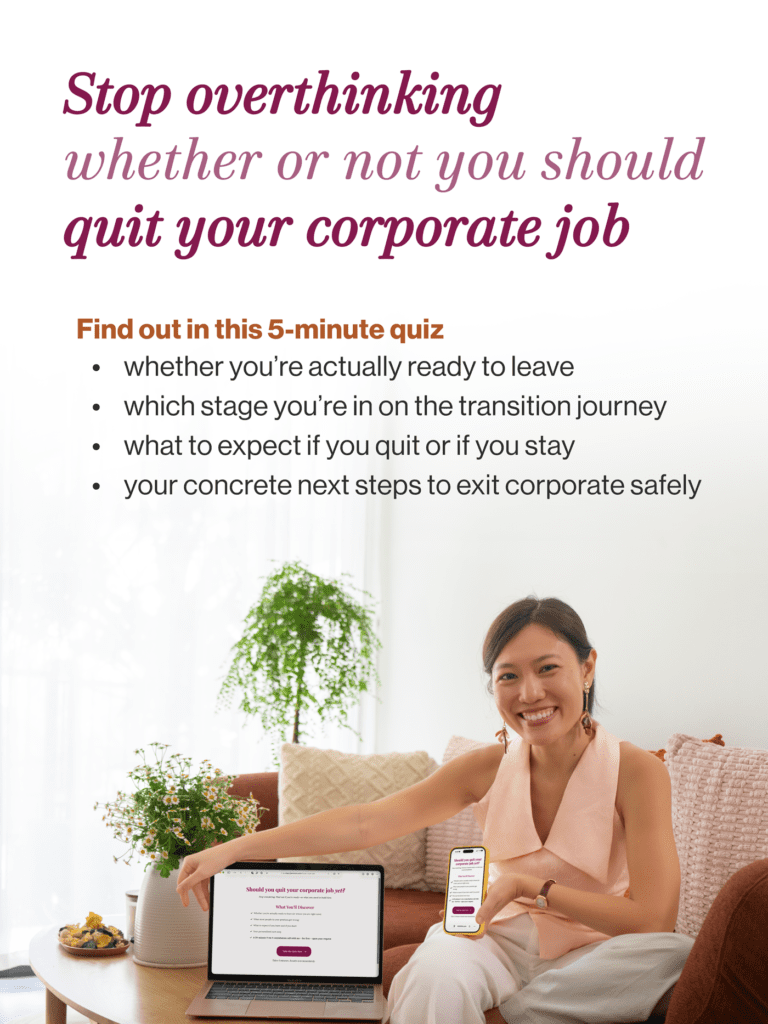
That’s what my “Should I Quit Yet?” quiz helps you figure out.
It shows you which of six transition stages you’re in, and what to focus on next.
👉 Take the quiz below.